Best Ink Tank Printer 2026: EcoTank vs MegaTank vs Smart Tank vs INKvestment
Tank printers cost more up front and roughly twenty times less per page. Here is which one to buy in 2026, with the cost-per-page math written out rather than asserted.

On this page
- Quick picks
- How we chose
- The cost-per-page maths
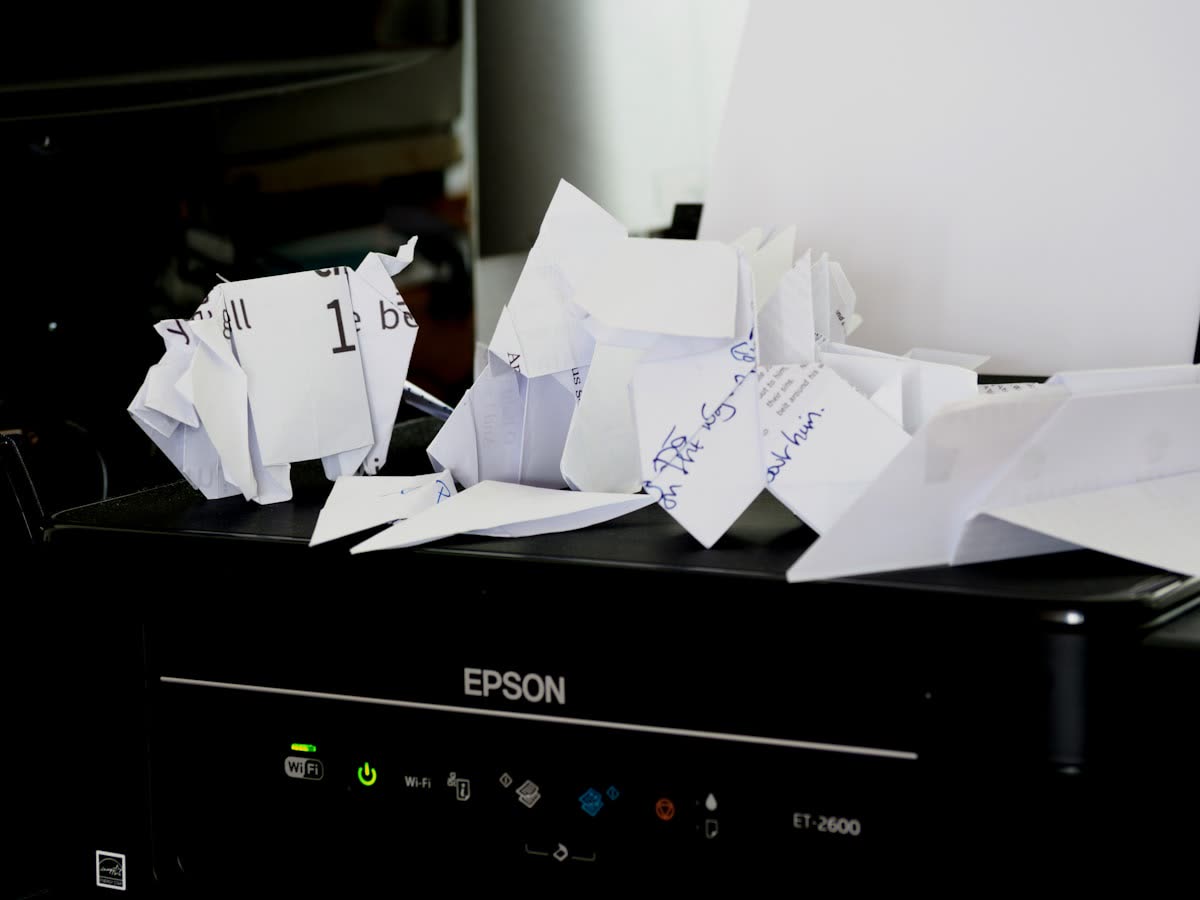
- Epson EcoTank ET-2900: best overall
- Epson EcoTank ET-4903: the home-office version
- Canon PIXMA G3270 MegaTank: best for photos
- Canon MAXIFY GX2020: pigment ink for business
- HP Smart Tank 5101 and 7301
- Brother INKvestment: not really a tank
- Epson EcoTank Photo ET-8550
- What to avoid
- Verdict
An ink tank printer stores ink in refillable reservoirs instead of chipped cartridges, and it changes the economics of home and small-office printing completely. Instead of paying $35 for a cartridge that holds 8 millilitres of ink, you pay $15 for a bottle that holds 65 to 70 millilitres and drops into a tank in about fifteen seconds. In 2026 there are four serious families to choose between: Epson EcoTank, Canon MegaTank, HP Smart Tank and Brother INKvestment. This guide picks between them and shows the arithmetic.
Quick picks
| Model | Type | Best for | Approx price |
|---|---|---|---|
| Epson EcoTank ET-2900 | Print/scan/copy | Best overall for homes | USD 240 / GBP 250 (ET-2920) / AUD 399 (ET-2910) |
| Epson EcoTank ET-4903 | Print/scan/copy/fax + ADF | Home office paperwork | USD 300 / AUD 419 (ET-4900) |
| Epson EcoTank ET-1910 | Print only | Cheapest entry to tank ink | USD 160 / AUD 299 |
| Canon PIXMA G3270 | Print/scan/copy | Photos plus documents | USD 230-270 / CAD 299-329 |
| Canon MAXIFY GX2020 | Print/scan/copy/fax | Pigment ink, business documents | USD 350-400 |
| HP Smart Tank 5101 / 7301 | Print/scan/copy | HP app households | USD 200-280 |
| Brother MFC-J1010DW (INKvestment) | Print/scan/copy | Smallest footprint, cartridge-based hybrid | USD 130-170 |
| Epson EcoTank Photo ET-8550 | 6-colour A3 photo | Serious photo printing | USD 750-850 |
How we chose

Three criteria, weighted heavily toward long-term cost and reliability rather than review-day print speed.
- Verified cost per page using each manufacturer's ISO yield figures and current street prices for bottles, not marketing claims about "years of ink".
- Clog resistance and serviceability. Tank printers have permanent printheads. On Epson and Canon models the head is not user-replaceable on most consumer units, so a terminal clog is a dead printer. Models with better nozzle-check and cleaning behaviour score higher.
- Ink availability in all our markets. Epson 522/552 and Canon GI-21 bottles are everywhere; some regional ink series are much harder to source.
The cost-per-page maths
This is the part most buying guides skip. Cost per page equals bottle price divided by ISO page yield. Below are figures for the mainstream 2026 models using typical US street prices. ISO yields are manufacturer figures at 5 percent coverage, which is a light text page; a page with a photo or heavy graphics can consume five to fifteen times more.
| System | Bottle/cartridge price | Black yield | Black cost/page | Colour cost/page (approx) |
|---|---|---|---|---|
| Epson EcoTank (T522/T552 bottles) | USD 13-17 / GBP 11-15 | 4,500-7,500 | 0.2-0.4 cents | 0.8-1.5 cents |
| Canon MegaTank (GI-21) | USD 13-20 / CAD 20-26 | 6,000 | 0.2-0.3 cents | 0.8-1.5 cents |
| HP Smart Tank (GT53/GT52) | USD 15-22 | 4,000-6,000 | 0.3-0.5 cents | 1-2 cents |
| Brother INKvestment (LC406/LC506 XL) | USD 25-40 per cartridge | 3,000-6,000 | 0.7-1.2 cents | 3-5 cents |
| Typical cartridge inkjet (XL) | USD 30-45 | 400-600 | 6-10 cents | 18-30 cents |
| Mono laser (Brother TN830XL) | USD 70-90 | 3,000 | 2.3-3 cents | n/a |
Worked example. A household printing 60 pages a month, 40 black and 20 colour. On a cartridge inkjet at 8 cents black and 22 cents colour that is $7.60 a month, or $274 over three years, on top of a $90 printer: $364 total. On an EcoTank ET-2900 at 0.3 cents black and 1.2 cents colour that is 36 cents a month, or about $13 over three years, on top of $240: $253 total. The tank printer is cheaper by year two and the gap widens forever after.
Epson EcoTank ET-2900: best overall

The 2026 seventh-generation EcoTank refresh brought three models that matter: the print-only ET-1910 at around $160, the ET-2900 all-in-one at around $240, and the ET-4903 with ADF and fax at around $300. The ET-2900 is the sweet spot.
Specs. 11 ppm black and 6 ppm colour ISO, 5760 x 1440 dpi, flatbed scanner, 1.44-inch colour LCD, 100-sheet input, Wi-Fi and USB, AirPrint and Mopria. Heat-Free PrecisionCore printhead.
Running cost. In-box ink is quoted at roughly 3,600 black and 6,500 colour pages. Refills are EcoFit bottles at $13 to $17. Under half a cent per black page.
Pros. Cheapest realistic cost per page of any consumer printer. Bottles are keyed so you cannot put cyan in the magenta tank. Epson Smart Panel handles setup, nozzle checks and scanning cleanly. Heat-free heads mean no warm-up delay.
Cons. No auto duplex, no ADF, single 100-sheet tray, plastic build. Slow on long documents.
Who it suits. Families, students, anyone printing 20 to 300 pages a month.
Known issues. Two, both shared across EcoTank. Heads clog after long idle periods; run a nozzle check monthly. And the waste ink pad counter eventually triggers a service message, covered in Epson ink pad end of service life. Neither is a reason to avoid the range, but both are reasons to buy only if you will actually use it.
Epson EcoTank ET-4903: the home-office version
Same engine, plus a 30-sheet automatic document feeder, fax and a slightly better control panel, for about $60 more. In the UK and Australia the equivalent is the ET-4900.
Who it suits. Anyone who scans multi-page documents: landlords, freelancers, anyone dealing with insurance or tax paperwork. The ADF alone justifies the premium.
Cons. Still no auto duplex printing on the base model, which is a real omission at this price. Check the exact SKU before buying if duplex matters.
Canon PIXMA G3270 MegaTank: best for photos

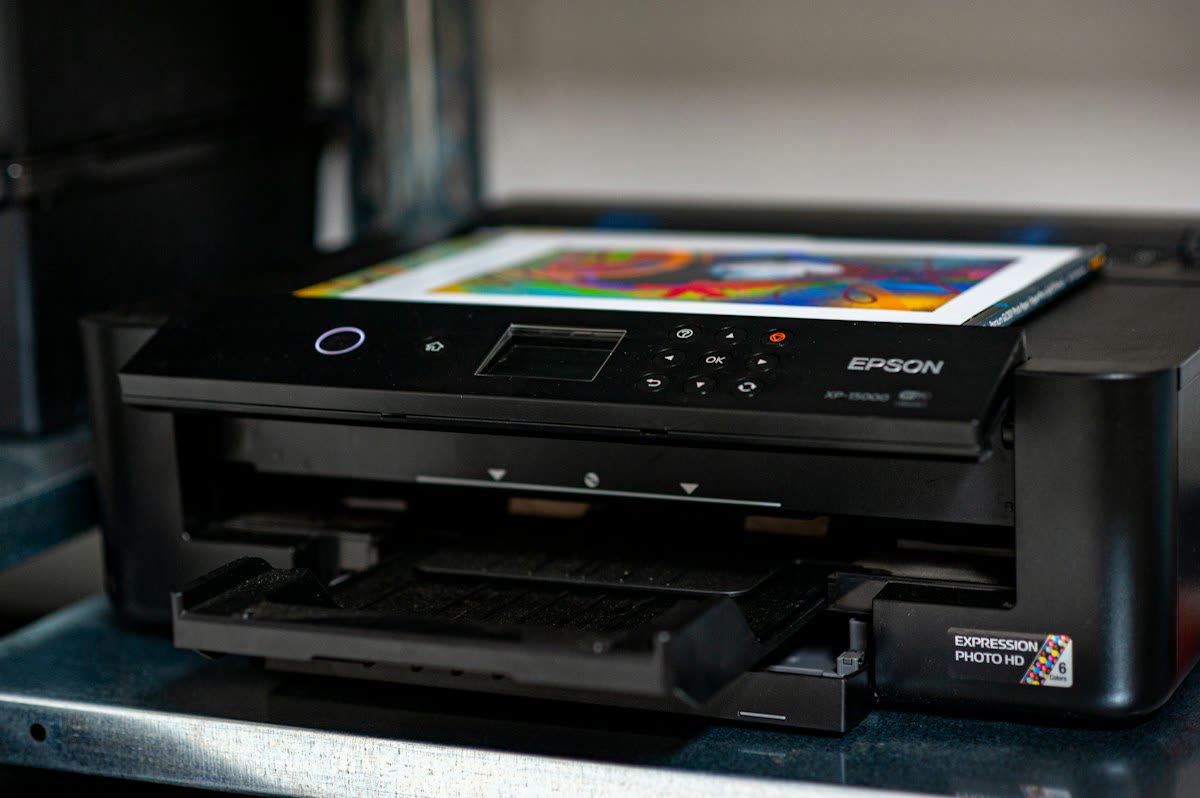
Canon's tank line uses a dye-based colour set with a pigment black, which is the classic PIXMA formula. On glossy photo paper the results are warmer and more saturated than a standard four-colour EcoTank.
Specs. Print, scan, copy, Wi-Fi, roughly 11 ipm black. GI-21 ink bottles. Front-mounted transparent tanks.
Running cost. Canon quotes about 6,000 black and 7,700 colour pages from the in-box fill; bottles are $13 to $20.
Pros. Best photo quality among mainstream tank all-in-ones. Tanks are easy to read at a glance. Canon's borderless 4x6 handling is reliable.
Cons. Slower plain-paper output than Epson. The ink absorber counter can trigger support code 5B00 after many cleaning cycles; see Canon error 5B00.
Canon MAXIFY GX2020: pigment ink for business
The MAXIFY GX line uses pigment ink in all four colours rather than dye. Pigment does not smear when highlighted and does not fade on plain paper, which matters for invoices, contracts and anything filed. Around $350 to $400.
Pros. Water-resistant, highlighter-safe output. Higher duty cycle than consumer EcoTanks. Auto duplex and ADF on most GX models.
Cons. Poor photo printing compared with dye models; pigment on glossy paper looks flat. Bulky. Pricey.
Who it suits. Small offices printing documents that must survive being filed, posted or highlighted.
HP Smart Tank 5101 and 7301
Genuine tank printers with genuine cheap ink, using GT53 black and GT52 colour bottles. The 5101 is the compact model around $200 to $250; the 7301 adds an ADF and better paper handling around $280.
Pros. The HP app remains the best mobile printing and scanning experience of the four brands. Widely stocked. Two-year warranty in several markets on registration.
Cons. Cost per page is slightly higher than Epson or Canon. HP has a documented history of firmware updates that tighten supply restrictions on its cartridge printers, and while Smart Tank models are not affected the same way, it is a reason to read our third-party supplies guide first.
Brother INKvestment: not really a tank
Brother's INKvestment system uses large high-capacity cartridges rather than refillable reservoirs. The 2026 refresh brought the MFC-J5010DW at $279.99 and the MFC-J5110DW at $359.99, both with LC506-series cartridges and optional Brother Refresh auto-replenishment.
Running cost. Better than ordinary cartridges, worse than true tanks: roughly one cent black and three to five cents colour.
Pros. Cartridge swaps are cleaner than bottle refills. Brother's paper handling, ADFs and duplex are genuinely better than Epson's at the same price. The J5110DW offers 500-sheet dual trays and single-pass duplex scanning, which no EcoTank near that price matches.
Cons. Not cost-competitive with EcoTank on colour. If pure cost per page is the goal, this is not the system.
Who it suits. Small businesses that value paper handling and want lower-than-cartridge costs without bottles.
Epson EcoTank Photo ET-8550
A six-colour A3+ tank printer at roughly $750 to $850, with grey and photo black inks added to the standard set. Print costs on 8x10 photo paper drop to a fraction of what a cartridge photo printer charges.
Who it suits. Photographers printing more than a handful of enlargements a month. Below that volume, a Canon PIXMA PRO-200 or a print lab is cheaper. See the photo printer guide for the full comparison.
What to avoid
- Buying a tank printer for very low volume. Under about ten pages a month, the head will clog before you recover the premium. Buy a mono laser.
- Third-party bottle ink in a warranty period. It is cheaper, but a clogged head from off-spec ink is not covered, and on most consumer tank models the head is not replaceable.
- Assuming "3 years of ink" means three years. It means the quoted ISO yield divided by an assumed light monthly volume. Print photos and it is three months.
- Overfilling tanks. Fill to the upper line and stop. Overfilled tanks cause ink to weep into the waste pad and accelerate the counter.
- Ignoring the maintenance box. Newer Epson L-series and some EcoTanks have a user-replaceable maintenance box; older ones do not. Check before buying if you print heavily.
Verdict
Buy the Epson EcoTank ET-2900 unless you have a specific reason not to. Step up to the ET-4903 if you scan multi-page documents, sideways to the Canon G3270 if photos matter more than speed, and up to the MAXIFY GX2020 if your output gets filed, posted or highlighted. Brother INKvestment is the right answer only when paper handling outweighs ink cost, and HP Smart Tank is the right answer when you want the HP app.
Whichever you pick, the first fill is the step people get wrong. Fill every tank to the line, let the initial ink charge run to completion without opening the lid, and print a nozzle check before you judge the quality. If it fights you, get help from a printer specialist rather than running six cleaning cycles and burning through the ink you bought it for.
Software mentioned in this guide
- Brother Mobile Connect
Brother's current mobile app for setup, printing, scanning and supplies iOS · Android - Canon PRINT
Canon's single mobile app for printing, scanning and printer setup iOS · Android - Epson Smart Panel
Epson's current mobile app for setup, printing, scanning and ink levels iOS · Android - HP Smart (the HP app)
HP's official setup, printing, scanning and ink app for home and small-office printers Windows · macOS · iOS
Printers covered here
Frequently asked questions
Which is the best ink tank printer in 2026?
The Epson EcoTank ET-2900 at around $240 for most homes. It offers the lowest realistic cost per page of any consumer printer, includes roughly 3,600 black and 6,500 colour pages of ink in the box, and refill bottles cost $13 to $17. Step up to the ET-4903 if you need an automatic document feeder and fax.
Is Epson EcoTank better than Canon MegaTank?
For plain documents and pure running cost, Epson is slightly ahead on speed and bottle price. For photographs on glossy paper, Canon's dye-based MegaTank output is warmer and more saturated. Both are far cheaper to run than any cartridge printer, so choose on output type rather than on cost.
How much does an ink tank printer really cost per page?
Between 0.2 and 0.5 cents for a black text page and roughly 1 to 2 cents for a mixed colour page at ISO 5 percent coverage. A photo-heavy page costs far more because coverage can be ten times higher. Cartridge inkjets sit at 6 to 10 cents black and 18 to 30 cents colour.
Do ink tank printers clog?
Yes. They have permanent printheads, and ink dries in the nozzles if the printer sits unused for weeks. Print a colour page at least every week or two and run a nozzle check monthly. On most consumer models the head is not user-replaceable, so a severe clog can end the printer.
Is Brother INKvestment an ink tank system?
Not strictly. INKvestment uses very high-capacity cartridges rather than refillable reservoirs. Running costs are better than ordinary cartridges at roughly one cent black and three to five cents colour, but still several times higher than a true tank system like EcoTank or MegaTank.
Can I use third-party ink in an EcoTank?
Physically yes, and the printer will not block it the way a chipped cartridge system does. But off-spec ink is the most common cause of permanent printhead clogs, and any resulting damage will not be covered by warranty. Genuine bottles are cheap enough that the saving rarely justifies the risk.
Technical writer focused on printer drivers, wireless setup and error-code troubleshooting.
Questions & comments (0)
No comments yet. Describe your printer model, operating system and the exact message you see; comments appear after review.
Ask about this page
Your comment appears after our team approves it. Or sign in to post faster.